Educate. Motivate. Activate.
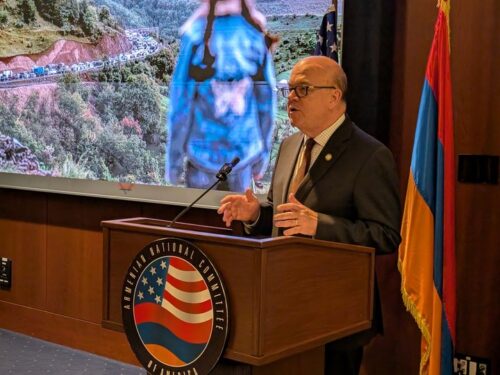
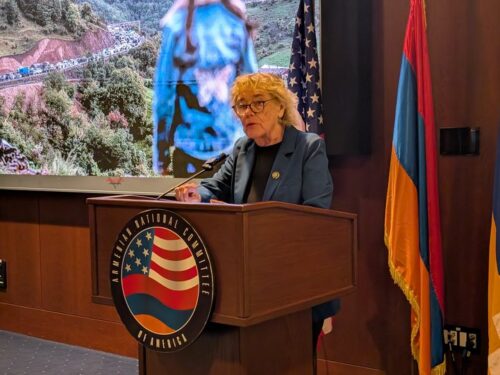
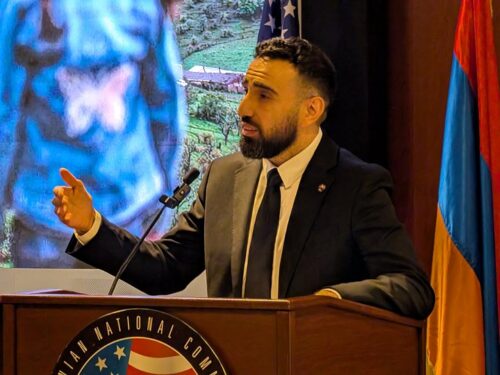
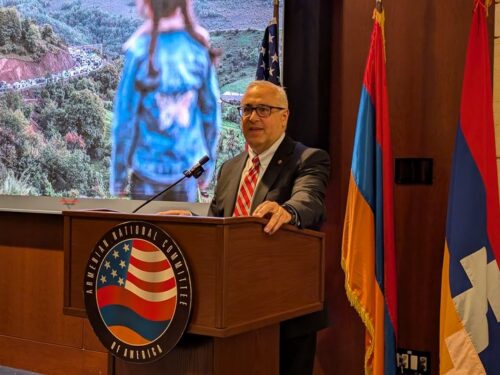
WASHINGTON, DC – A dozen Members of Congress demanded Azerbaijan release Armenian hostages held in Baku and open Artsakh to the safe, collective, and protected return of its indigenous population, joining Armenian American advocates, clergy, and international legal experts at “Accountability | 2026 – Artsakh: Justice. Freedom. Right of Return.”
The Capitol Hill program marked three years since Azerbaijan’s genocidal ethnic cleansing of Artsakh and capped two days of advocacy – organized by the ANCA Eastern Region, ANCA Western Region, and ANCA National Headquarters – that brought over 100 advocates from more than 30 states into every one of the 435 U.S. House and 100 U.S. Senate offices.
The program was live-streamed on ANCA social channels and is available here:
Over two days of Congressional meetings, advocates pressed for enforcement of Section 907 of the FREEDOM Support Act, Global Magnitsky sanctions against Azerbaijani war criminals, co-sponsorship of the ARMENIA Security Partnership Act (H.R.6840) and the Azerbaijan Sanctions Review Act (H.R.5369), the right of return for Artsakh’s displaced, and protection of Armenian Christian heritage sites. The full slate of ANCA priorities is available at anca.org/priorities.
Free the Hostages
Rep. Brad Sherman (D-CA), Vice Chair of the Congressional Armenian Caucus, detailed the February sentencing of sixteen Armenian defendants before an Azerbaijani military court. “The war is over. It’s time to release the prisoners of war,” Sherman said, noting that civilians were tried in a military court on some 2,500 charges in proceedings closed to independent observers. He reported that the House Foreign Affairs Committee adopted his amendment demanding the release of Armenian POWs and political prisoners by a vote of 44 to 7.
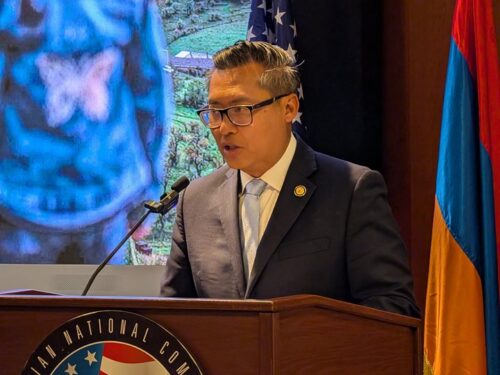
Rep. Vince Fong (R-CA) cited the nineteen Armenian hostages Azerbaijan continues to hold, including presidents, foreign ministers, and parliamentary leaders of Artsakh. “We must call for the immediate and unconditional release of all Armenian hostages and POWs whose unlawful detention and reported mistreatment remain a barrier to lasting peace,” Fong said.
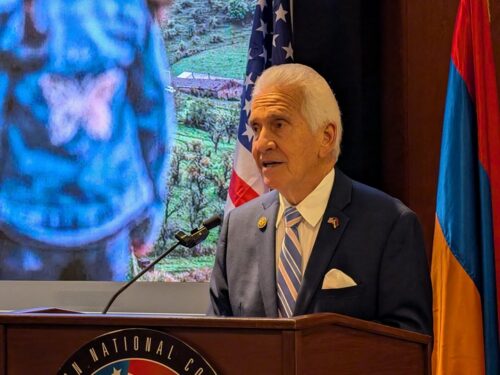
Rep. Jim Costa (D-CA), who grew up among Armenian Genocide survivors in the Central Valley and co-sponsored the Azerbaijan Sanctions Review Act (H.R.5369), tied the hostages to the terms of any settlement. “You can’t have a lasting peace, of which Azerbaijan is a cosigner, unless you have justice, unless you have accountability, unless you have a respect for fundamental human rights,” Costa said. That means, he added, the immediate release of the Armenian prisoners and civilian detainees, protection of Armenian culture and religious heritage, and the safe and dignified return of the displaced.
Rep. Luz Rivas (D-CA), who represents the San Fernando Valley and co-sponsors both H.R.5369 and the ARMENIA Security Partnership Act, recounted the letter she received from the Azerbaijani consulate during her first year in the California legislature, warning her about the Armenian constituents visiting her office and enclosing photographs of those meetings. “They were trying to intimidate a new member in the legislature, and it didn’t work,” Rivas said. “Because I’m with the Armenian community.”
Reverse the Ethnic Cleansing
Congressional Armenian Caucus Co-Chair David Valadao (R-CA), who traveled to Artsakh in 2017 over State Department objections and authored the amendment funding HALO Trust landmine clearance there, pointed to the International Court of Justice order requiring Azerbaijan to permit displaced Armenians to return safely. “It’s past time for Azerbaijan to follow that order,” Valadao said. “A lasting peace cannot mean leaving these people behind or asking Armenian families to simply accept that they can never return to their homes.”
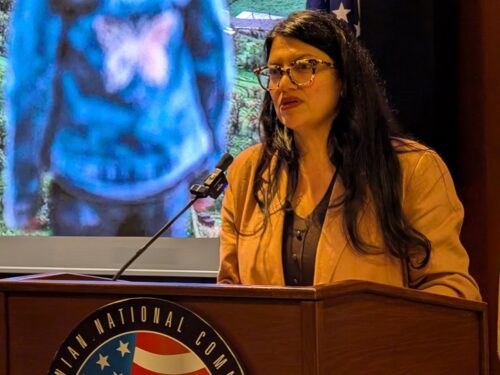
Rep. Rashida Tlaib (D-MI) drew on her own community’s history. “It’s been three years since the ethnic cleansing of Armenians from Artsakh by Azerbaijan. There has been no justice. There’s been no return of displaced families,” Tlaib said. “As a Palestinian American I know these images, images of families trying to escape with what few prized possessions that they carry, not knowing if or when they will be able to return.”
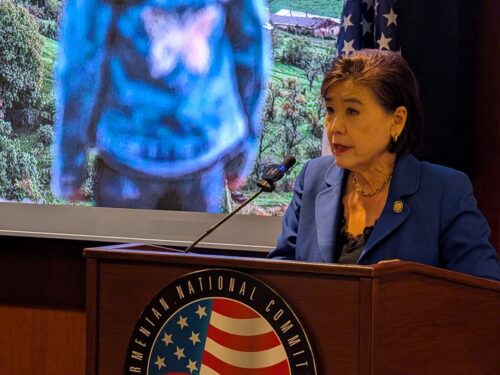
Two other speakers had seen Artsakh before Azerbaijan emptied it. Rep. Judy Chu (D-CA), who represents the nation’s oldest Armenian American community in Pasadena, traveled there in 2019 and was barred from Azerbaijan on her return, a distinction she calls a badge of honor. “I did see that Artsakh was a place where Armenian people were thriving and proud,” Chu said. “It breaks my heart to consider that those people I visited just a few years ago are now refugees in Armenia.” Rep. Laura Friedman (D-CA), who visited while serving in the California State Assembly, warned against “a slow-motion erasure of the Armenian people and the nation of Armenia.” Friedman called for unconditional release of the hostages, an end to military aid to Azerbaijan, and U.S. guarantees for Armenian sovereignty. “Peace has to start with accountability, lasting security and respect for sovereignty.”
Rep. Zoe Lofgren (D-CA), who chairs the California Democratic delegation, credited former Rep. Anna Eshoo with opening her eyes to the Armenian Genocide and told advocates the delegation “is on your side.”
End the Impunity
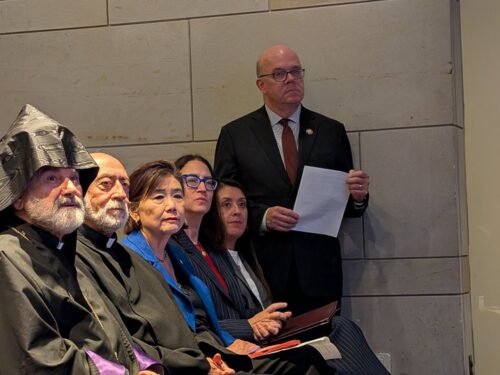
Rep. Jim McGovern (D-MA), co-chair of the Tom Lantos Human Rights Commission and Ranking Member of the House Rules Committee, represents Worcester, home to the first Armenian church built in the Western Hemisphere. He argued that the machinery of international accountability is being dismantled as Azerbaijan’s crimes go unanswered.
“It is incredibly important for the sake of morality and justice that the United States and the international community work together to hold the government of Azerbaijan accountable for ethnic cleansing and forced displacement of ethnic Armenians from their homes,” McGovern said. “Accountability is fundamental to human rights.” He pointed to the elimination of the State Department’s Office of Global Criminal Justice and efforts to dismantle the International Criminal Court. “Unfortunately, the accountability agenda is being ignored.” McGovern called for compensation for Armenians who lost homes, businesses, and livelihoods, and for a peace “that upholds the sovereignty and the dignity of Armenia and that guarantees its security from any further Azerbaijani aggression.”
Rep. Dave Min (D-CA), a co-sponsor of the ARMENIA Security Partnership Act, described the Armenian Genocide Memorial taking shape in the Irvine Great Park, in a district with a fast-growing Armenian American community. “I had the privilege of seeing a mockup of this memorial. It is beautiful, and it is so important because we cannot forget the Armenian Genocide,” Min said. He warned that the lesson is not confined to history. “At a time when we face so many threats around the world and yes, here at home, we cannot forget that lesson of history. This is something that we cannot be silent about right now.” Min credited the advocates in the room with building the Congressional Armenian Caucus into a powerhouse. “You’re punching way above your weight.”
Stop the Erasure
Fr. Sarkis Aktavoukian, Pastor of Soorp Khatch Armenian Church, prayed for the churches, monasteries, cemeteries, and khachkars destroyed or desecrated since 2023. “Artsakh is the land where everything smells Armenian,” he said. “Lord, do not allow the memory of a people to be buried beneath the ruins of its heritage.”
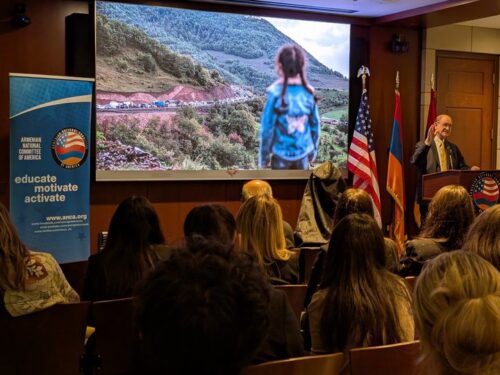
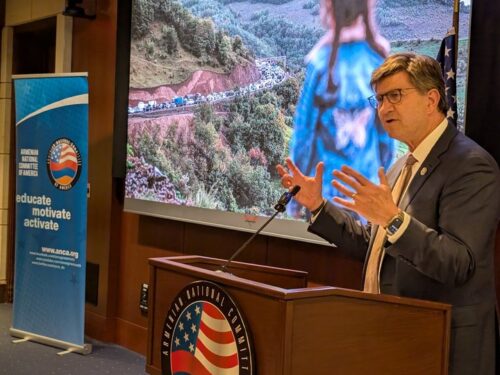
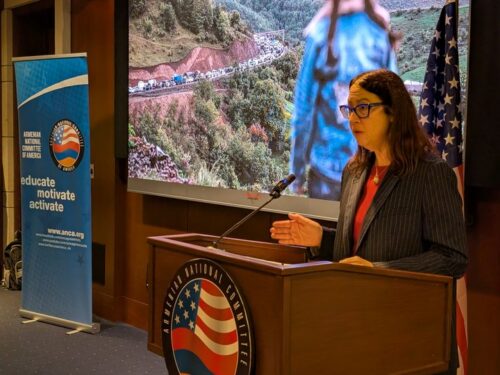
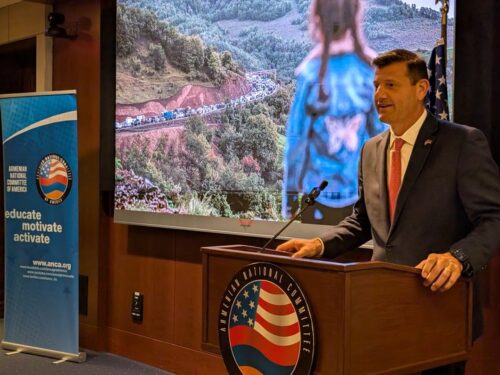
Rep. Brad Schneider (D-IL), an original co-sponsor of the 2019 Armenian Genocide Resolution, spoke to Artsakh photographer David Ghahramanyan’s image of the exodus displayed behind the podium, and to the girl in it. “I’m guessing she’s probably eight, nine, ten years old, and wondering what’s happening and what to make of this,” Schneider said. “I think of the responsibility we have on our shoulders to make sure that we can answer her question, that what’s happening is wrong, shouldn’t have happened.” He called for the hostages to be reunited with their families and pressed for heritage protection. “Standing together as a caucus, standing united, we are protecting the churches, monasteries, cemeteries, and other cultural heritage sites that testify to the centuries of Armenian history in Artsakh.”
Rep. Fong called for investigations into the destruction of Armenian Christian heritage. Rep. Chu, who this year requested robust federal funding for Artsakh’s 150,000 refugees and for Armenia’s security and defense, tied the relics to the people who made them. “I think often about Artsakh, the empty and damaged homes, the cultural and religious relics destroyed,” Chu said. “That’s why I continue to demand the preservation of those relics as well as the return of the political prisoners from Azerbaijan.” She also called on the U.S. to prohibit military and security assistance to Azerbaijan.
A Peace Process That Leaves Prisoners Behind
Keynote speaker Siranush Sahakyan, Executive Director of the Armenian Legal Center for Justice and Human Rights and President of the International and Comparative Law Center, represents Armenian prisoners and their families in international proceedings. She examined what the peace process has actually delivered to them.
“What we are witnessing runs directly against the promise of peace,” Sahakyan said. “Prisoners remain detained while the safeguards protecting them and their families are being dismantled, deepening the suffering that a peace process should resolve.” She noted that the agreement initialed last August contains no explicit commitment to release Armenian prisoners or guarantee protected return, while Article 15 sets a one-month deadline for withdrawing interstate legal claims. There is a timetable for ending litigation, she said, but none for releasing the prisoners.
Sahakyan reported that the International Committee of the Red Cross closed its permanent delegation in September 2025 at Azerbaijan’s decision, and that no ICRC visits were permitted throughout 2026, ending independent oversight of detainees’ treatment. Her review of the Vardanyan judgment found it recast Artsakh’s institutions as a criminal organization to attribute responsibility without establishing individual conduct, relying in part on charitable activity as evidence of criminality.
She closed by contrasting what the process has made possible with what it has not. “If arrangements can be made for goods to cross borders, why can they not be made for a family to visit a prisoner and a consular representative to check his welfare or an independent lawyer to defend him? And what does that tell us about the peace being proclaimed?”
“To Normalize Genocide Is to Invite Violence”
ANCA Executive Director Aram Hamparian warned advocates about the direction of U.S. policy.
“Current U.S. policy, sadly, is off course,” Hamparian said. “We are normalizing the genocide of Artsakh. We’re helping Azerbaijan consolidate the ethnic cleansing of an indigenous people. We’re watching as this crime is consecrated, transformed into policy.” He pointed to the U.S. Ambassador to Azerbaijan dancing in Shushi, the cultural center of Armenian life for thousands of years. “It’s one thing to visit. I understand a visit. I don’t approve of a visit, but I understand a visit. It’s normalizing. When you dance, you’re celebrating.”
Hamparian described a peace process “that creates the conditions for renewed conflict much more than it creates the conditions for enduring peace. One that leaves Armenian hostages abandoned, Artsakh refugees unreturned, illegal occupation accepted, Azerbaijani war crimes unpunished, Christian holy sites forsaken, and Armenian sovereignty, Armenian security outsourced to realtors, real estate people, and ballroom donors.” He noted that none of the Members of Congress advocates met with that day had meaningful insight into the peace process or the corridor across southern Armenia.
“We’re not guests in this house,” Hamparian told the advocates, speaking of the U.S. Capitol. “Here, in this altar of democracy, within these walls, we’re citizens, not subjects, full stakeholders in our American enterprise.”
What Grassroots Power Looks Like
ANCA National Grassroots Director Gev Iskajyan opened the program by measuring three years of captivity against three years of advocacy.
“Three years since the families of Davit Ishkhanyan, Ruben Vardanyan, Levon Mnatsakanyan, Davit Babayan, and the rest of our hostages last saw the people they love,” Iskajyan said. “Three years in which every force on earth has tried to silence the voices of Artsakh. Well, they failed.” He traced the legislative record to grassroots work: H.R.6840, H.R.5369, H.R.2585, and the amendments demanding hostage release and heritage protection. “None of those bills wrote themselves. They exist because advocates walked these halls and would not let Artsakh be forgotten.”
Iskajyan closed by quoting Azerbaijani President Ilham Aliyev: “For us, the number one enemy is the Armenian lobby. Their scope of influence is quite broad, and we must be prepared to fight against it.” His reply: “He’s right. Our influence is broad and far-reaching, and they should be prepared, because we are just getting started.”
ANCA Eastern Region Chairman Dr. Ara Chalian turned to the same image of Artsakh’s exodus. “That young lady with her back turned to us shows part of our power,” Chalian said. “But look at her shoulders and her head. You feel the strength.” He told advocates that their case on Capitol Hill carries beyond their own community. “Every time we speak, we speak for others. Every time we demand, we reflect the needs of others. And we build a better America.”
“Artsakh Is Not History”
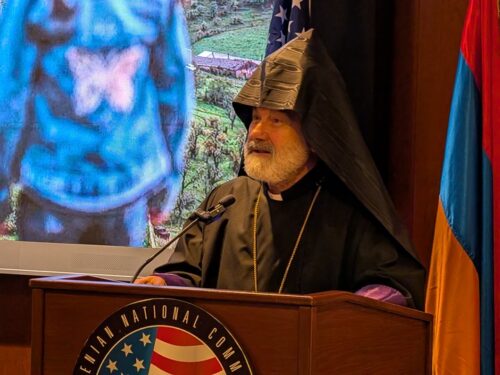
His Eminence Archbishop Anoushavan Tanielian, Prelate of the Eastern Prelacy of the Armenian Apostolic Church, closed the evening by telling the gathering that Artsakh’s survival is a matter of insistence.
“Artsakh is not history, Artsakh is not past,” the Archbishop said. He recounted telling athletes at this year’s 92nd AYF Olympics in New Jersey that they had come not only for the games but “to say to the world that we are Armenia and we are Artsakh, and there is no power in this world which can take from our hearts, from our minds, from our lives, this understanding.”
The Archbishop turned to “Sarkis Gugunian’s Song,” in which a lifeboat breaks apart in a stormy sea and the waves rise to sink it, and the singer refuses to surrender hope. “The most powerful energy in this world is hope,” he said. “Hope is the greatest power, my dear brothers and sisters.”
#####